
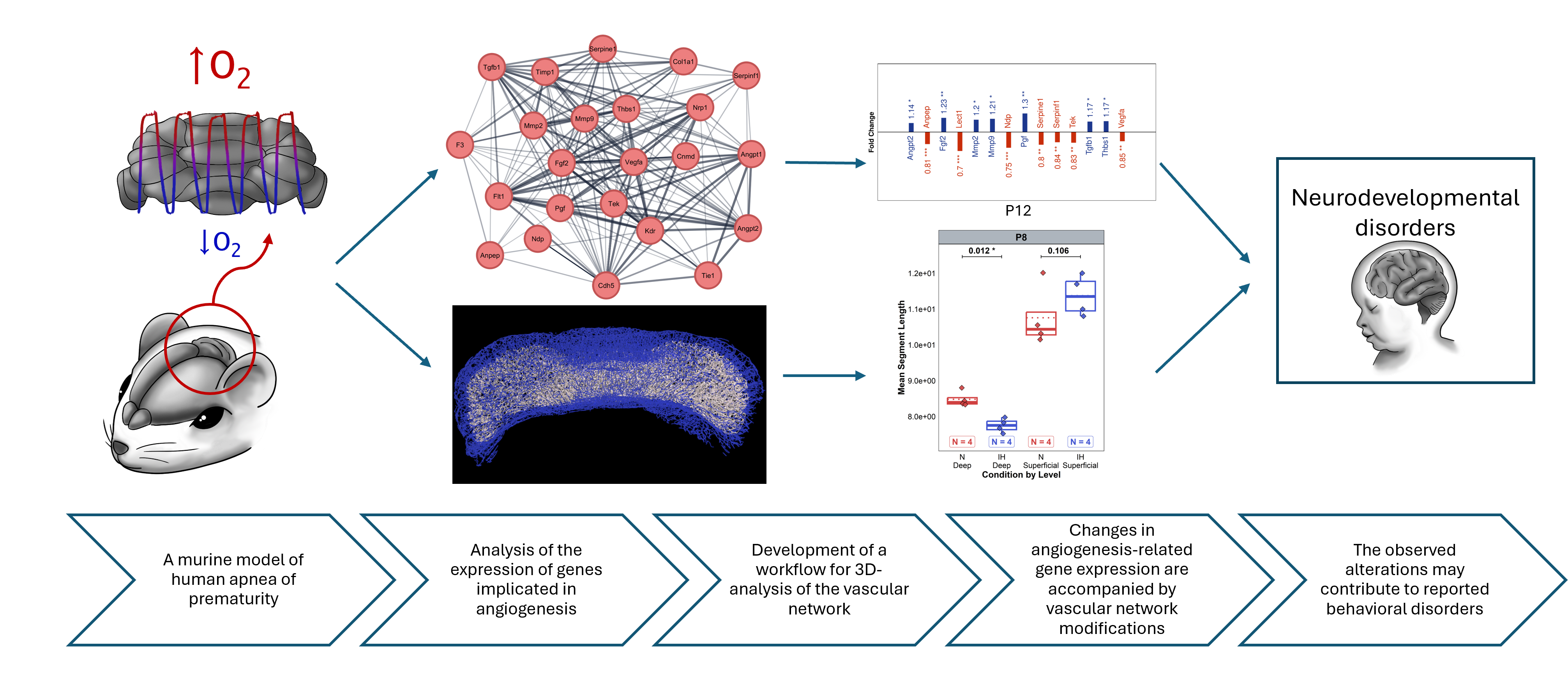
Highlights
- Intermittent hypoxia induces multiphasic vascular changes in the developing cerebellum, with initial expansion at P4 followed by normalization and persistent long-term alterations.
- Novel 3D imaging workflow combining IMARIS and VesselVio enables quantitative analysis of superficial versus deep cerebellar vascular networks.
- Transcriptomic dysregulation of 23 angiogenesis genes persists long after cessation of hypoxic exposure, particularly affecting VEGF, angiopoietin, and MMP pathways.
- Superficial and deep vascular networks respond differently to intermittent hypoxia, revealing distinct remodeling patterns throughout development.
- Vascular disruptions parallel neurogenic deficits, highlighting the interconnected nature of angio- and neurogenesis in apnea of prematurity.
Reuse
Citation
BibTeX citation:
@article{rodriguez-duboc2026,
  author = {Rodriguez-Duboc, Agalic and Racine, Camille and
    Basille-Dugay, Magali and Vaudry, David and Gonzalez, Benjamin and
    Burel, Delphine},
  title = {Innovative {3D-image} Analysis of Cerebellar Vascularization
    Highlights Angiogenic Gene Dysregulations in a Murine Model of Apnea
    of Prematurity},
  journal = {The Cerebellum},
  volume = {25},
  number = {3},
  pages = {62},
  date = {2026-04-28},
  url = {https://link.springer.com/article/10.1007/s12311-026-02006-1},
  doi = {10.1007/s12311-026-02006-1},
  issn = {1473-4222},
  langid = {en},
  abstract = {Apnea of prematurity (AOP) affects 50\% of preterm infants
    causing intermittent hypoxia (IH), which can lead to long-term
    neurodevelopmental deficits. Cerebellar abnormalities have been
    observed in AOP but the relationship between vascular alterations
    and neural development remains unclear. This study investigates how
    IH affects cerebellar angiogenesis using a murine model of AOP. We
    developed an innovative 3D imaging workflow combining IMARIS and
    VesselVio software to quantitatively analyze cerebellar
    vascularization at different postnatal stages (P4, P8, P12, P21, and
    P70). We correlate these results with a transcriptomic analysis of
    23 angiogenesis-related genes in the same stages to uncover the
    associated molecular pathways. We found that IH induced significant
    vascular changes, particularly at P4, with a global increase in
    vascular-network dimensions. By P8, the vascular network normalized,
    but genes were downregulated in all pathways studied. After P12, at
    the end of the IH protocol, transcriptional regulations vary but
    persist long-term. Moreover, differential analysis showed distinct
    effects on superficial versus deep vascular networks, allowing for a
    more precise understanding of remodeling patterns throughout
    development. Overall, transcriptomic changes were associated with
    morphological alterations in a time-dependent manner, suggesting a
    multiphasic IH response through development with lasting effects.
    Key regulations included VEGF, angiopoietin, and matrix
    metalloprotease signaling. These findings demonstrate that IH
    disrupts cerebellar angiogenesis in parallel with neurogenesis,
    potentially contributing to the neurodevelopmental deficits observed
    in AOP. Thus, the interconnected nature of angio- and neurogenesis
    during cerebellar development makes it crucial to take vascular
    aspects into account in therapeutic approaches to neurodevelopmental
    disorders.}
}
For attribution, please cite this work as:
Rodriguez-Duboc, A., Racine, C., Basille-Dugay, M., Vaudry, D.,
Gonzalez, B., & Burel, D. (2026). Innovative 3D-image analysis of
cerebellar vascularization highlights angiogenic gene dysregulations in
a murine model of apnea of prematurity. The Cerebellum,
25(3), 62. https://doi.org/10.1007/s12311-026-02006-1